Is Hilton Part of Marriott?
In the global hospitality industry, Hilton and Marriott stand among the world’s leading hotel groups. Both are household names, recognized for their extensive portfolios of hotel brands and their strong presence across different segments of the travel market.
With thousands of properties worldwide, these two hotel giants use their unique brand identities to attract specific types of guests — from travelers seeking affordable and value-focused stays to those looking for premium and luxury experiences. Whether it’s a budget-friendly business trip or an unforgettable high-end getaway, both hotel groups offer options for nearly every type of traveler.
Because Hilton and Marriott properties are so widely available, many travelers encounter these two brands when booking accommodations. Some even mistakenly believe that Hilton is part of Marriott, or that the two companies are somehow connected. This raises the question: Is Hilton Part of Marriott?
Don’t worry, this article will delve into the relationship between Hilton and Marriott. and help readers understand their differences so they can make more informed accommodation choices when traveling.

Are Hilton and Marriott the Same?
First of all, let’s be clear: Hilton is not a part of Marriott; they are completely separate operating hotel groups, each with its portfolio of brands and management systems. and loyalty programs. Although the two brands have a global presence, there are many similarities in operating magic and brand structure. and duration coverage, but neither of them has any partnerships, mergers, or affiliations. What you need to know is that Hilton has more than 25 brands, while Marriott has more than 40 brands, and the two have different brand architecture. Hilton uses a franchising and management contract-based model, while Marriott is more asset-light and relies on management and franchising to operate its hotels.
The Hilton Honors loyalty program and the Marriott Bonvoy loyalty program are different, and members cannot use each other at all. This includes earning points and enjoying the benefits of the other hotel brand. These two are relatively obvious market competition relationships. They respectively carry out many different modes of accommodation experience around the world, as well as the market share of business and leisure travelers, etc. So, the two hotel groups are completely separate brands.
Overview of Hilton
Hilton Hotels & Resorts was founded in 1919 by Conrad Hilton and is headquartered in McLean, Virginia, USA. It is an American multinational hotel company with many hotel brands and resorts, among others. After more than a century of development, Hilton has become one of the world’s most influential hotel groups. with more than 9,000 hotels in more than 141 countries and territories.
Hilton’s main hotel brands

Hilton has more than 25 different positioning brands, tailored to meet the needs of different markets and different types of travelers.
1. Distinguish between different passenger needs:
- Luxury brands: Waldorf Astoria, Conrad, LXR Hotels & Resorts
- High-end: Hilton Hotels & Resorts (Hilton), Curio Collection, Canopy by Hilton
- Mid-range brands: DoubleTree by Hilton, Tapestry Collection, Hilton Garden Inn
- Budget brands: Hampton by Hilton, Tru by Hilton
- Long-stay brands: Homewood Suites, Home2 Suites, Hilton Grand Vacations
Click here to view the details: Hilton Hotel Brands.
2. Market demand:
- Hilton Hotels & Resorts:
- With a presence in more than 90 countries around the world, Hilton Hotels & Resorts appeals to business travelers. and leisure travelers with its signature spirit of “Hilton-style” hospitality by providing high-quality accommodations.
- Waldorf Astoria & Resorts:
- Waldorf Astoria can be said to be a luxury high-end brand under Hilton. which is distributed in many top and bustling cities such as New York, Dubai, and Paris. The brand hotel has won the love and praise of high-end travelers for its personalized service, fine dining, unique architecture, and luxury accommodation experiences.
- Hampton by Hilton:
- Hampton by Hilton, a hotel brand owned by Hilton, is committed to providing quality stay experiences, hilton free breakfast, and friendly service to win the love of business and leisure travelers. It is popular in North America and subspecies markets.
Related Articles:
- Hilton Garden Inn VS Doubletree: Which is Better?
- Top 10+ Best Hilton Hotels in Florida
- Best Hilton in Paris Flyertalk for 2025
- Tybee Island VS Hilton Head: Which is Better?
Hilton Honors Membership Program
Hilton Honors is Hilton’s loyalty program that offers members a variety of benefits. including points accumulation, free late stays, and room upgrades. Hilton Honors offers three levels of membership: Silver, Gold, and Diamond. You need to earn according to the number of nights, number of time, and points. Each level needs to meet the following conditions:
- Hilton Silver Status: 10 nights, 4 stays, or 25,000 base points.
- Hilton Gold Status: 25 nights, 15 stays, or 60,000 base points.
- Hilton Diamond Status: 50 nights, 25 stays, or 115,000 basic points.
If you still want to upgrade quickly at this point, there is no challenge to reach your desired Hilton level status. Such as Hilton Diamond Status and Hilton Gold Status. Then you can click the red button below to quickly get to the Hilton membership upgrade page.
Related Articles:
Overview of Marriott
Marriott International was founded in 1927 by J. Willard Marriott and is headquartered in Bethesda, Maryland, USA. Marriott International, Inc. is the parent company of the Marriott Hotel Brand, a leading global hotel company with a portfolio of hotel brands that meet the needs of different market segments. Marriott operates over 9600 hotels in 143 countries and territories and is one of the world’s largest hotel companies.
Marriott’s main hotel brands

Marriott’s portfolio of more than 40 brands, ranging from luxury to budget hotels. includes thousands of hotels worldwide. It also has several brands, ranging from luxury to budget hotels, each tailored to a different type of traveler.
- Luxury brands: The Ritz-Carlton, St. Regis, JW Marriott. The brand is known for its refined elegance and tall, young service.
- High-end brand: Marriott Hotels: Known for its high-end hospitality and innovation.
- Sheraton is an iconic global hotel brand with cities and resorts around the world.
- Westin: The hotel is known for its wellness program, featuring the iconic Dream Bed and fitness program.
- Mid-range brands: Courtyard by Marriott, Four Points by Sheraton.
- Budget brands: Fairfield by Marriott, Moxy Hotels.
- Long-stay brands: House Inn, TownePlace Suites, Element.
Click here to view the details: Marriott Bonvoy Hotel Brands.
Marriott Bonvoy Membership program
Marriott Bonvoy is Marriott International’s global loyalty program that offers travelers a wealth of rewards and exclusive benefits. You can stay in more than 40 brands under Marriott and the opposite shore. accumulate points, redeem the accommodation for free, and realize a variety of rights and interests such as room upgrades and member benefits upgrades. Marriott Bonvoy Elite Membership is divided into 5 elite levels: Silver, Gold, Platinum, Titanium, and Ambassador. To achieve these levels of status, you need to complete the following challenges:
- Marriott Silver Elite: Stay of 10 nights, 10% bonus points.
- Marriott Gold Elite: Stay of 25 nights, 25% bonus points.
- Marriott Platinum Elite: Stay of 50 nights, 50% bonus points.
- Marriott Titanium Elite: 75% bonus points for the least stay of 75 nights.
- Marriott Ambassador Elite: Stay of 100 nights with a qualifying hotel spend of more than $14,000. 75% bonus points.
Related Articles: Marriott Bonvoy: The Best Hotel Loyalty Program.
Hilton and Marriott’s performance
Hilton Worldwide Holdings Inc.
Hilton reported strong growth in its global hotel network in 2025. For the full year, Hilton generated approximately $12.04 billion in total revenue, up from $11.17 billion in 2024. Net income was approximately $1.46 billion, while adjusted EBITDA reached $3.73 billion. System-wide comparable RevPAR increased 0.4% for the year.
By the end of 2025, Hilton had 9,158 properties with approximately 1.35 million rooms across 143 countries and territories. The company added approximately 97,000 rooms during the year, resulting in 6.7% net unit growth. Its development pipeline also reached a record 520,500 rooms.
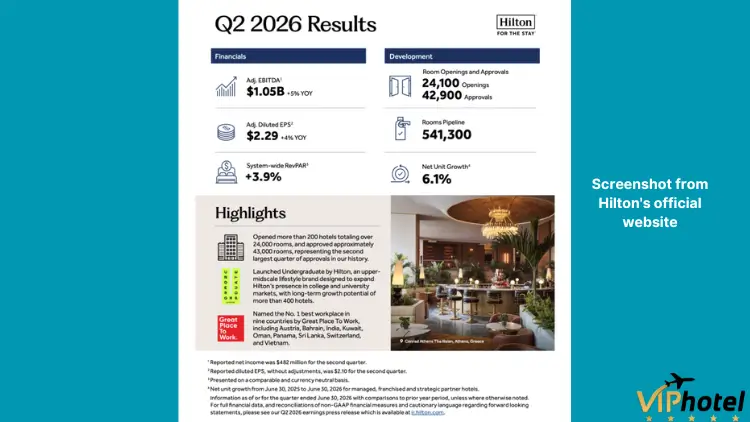
Hilton continued to expand in 2026. In the second quarter of 2026, global comparable RevPAR increased 3.9% year over year, while net income reached $482 million. Hilton also raised its full-year 2026 RevPAR growth outlook to 3.0%–3.5%, reflecting stronger expectations for hotel demand.
Check the latest content on the official website: Hilton Reports Second Quarter Results.
Marriott International
Marriott International, Inc.
Marriott International continued to strengthen its position as one of the world’s largest hotel companies in 2025. For the full year, worldwide comparable RevPAR increased 2.0 percent, while net rooms grew more than 4.3 percent. Marriott reported approximately $2.60 billion in net income and $5.38 billion in adjusted EBITDA for the year. The company added nearly 100,000 rooms globally, and its development pipeline reached a record approximately 4,100 properties with nearly 610,000 rooms at the end of 2025.
Marriott’s expansion continued in 2026. As of June 30, 2026, the company had more than 10,000 properties and nearly 1.814 million rooms worldwide. In the second quarter of 2026, worldwide comparable RevPAR increased 3.4 percent year over year, with RevPAR rising 5.0 percent in the U.S. & Canada while international RevPAR declined 0.5 percent. Reported net income totaled $766 million, while adjusted net income reached $844 million and adjusted EBITDA totaled $1.59 billion.
Marriott also added approximately 17,900 net rooms during the second quarter. Its global development pipeline reached a record 4,186 properties with approximately 629,000 rooms, with about 44 percent of pipeline rooms under construction. Meanwhile, the Marriott Bonvoy loyalty program surpassed 295 million members worldwide.
For full-year 2026, Marriott currently expects worldwide RevPAR to increase approximately 3.0 to 3.5 percent, with net rooms growth of 4.5 to 5 percent. The company expects adjusted EBITDA of approximately $5.97 billion to $6.03 billion for the year.
Check the latest content on the official website: latest data from Marriott’s official website.
Hilton and Marriott cooperation cases and market competition
Hilton and Marriott, the world’s leading hotel companies, have partnered in North America, Europe, and China to expand business and enhance market competitiveness. The following are some specific cooperation cases and market competition:
Marriott Corporation Cases
- Rebranding Zleep Hotel in partnership with Core Hospitality:
- In the global travel news, someone has published about the European store to Marriott, has reached an agreement with Marriott related matters. In 2024, Core Hospitality announced that 14 of its Zleep hotels in Denmark would be converted to Marriott’s Four Points Flex by Sheraton brand. However, the Zleep brand was founded by Peter Haaber in Denmark in 2003, invested by Deutsche Hospitality in 2019, and Huazhu Group completed the acquisition of Deutsche Hotels in 2020. Zleep brand belongs to the economic grade of the Huazhu Group. This partnership with Marriott is a big step forward for the Nordic hotel market.
- Strategic cooperation with Deokyoon Group:
- On January 23, 2024, Marriott Group signed a strategic agreement with Deoko Group, which plans to add more than 100 of Deoko’s full-service hotels to Marriott’s Tribute Portfolio hotel brand through cooperation. This cooperation has accelerated the Marriott market in China, and the Tokero Group has leveraged Marriott’s reputation, brand influence, and management experience to enhance itself.
- Marriott Acquires citizenM: Further Expanding Its Lifestyle Hotel Portfolio
- In April 2025, Marriott International announced the acquisition of the lifestyle hotel brand citizenM. At the time, the brand had 36 hotels and approximately 8,544 rooms across major cities in Europe, the Americas, and the Asia-Pacific region. The acquisition demonstrates Marriott’s strategy of quickly entering new market segments through brand acquisitions while further expanding the range of hotel options available through Marriott Bonvoy.
- Marriott Partners with VERKEHRSBUERO: Rapidly Expanding Its European Presence Through Hotel Conversions
- In May 2025, Marriott International signed a partnership agreement with Austria-based VERKEHRSBUERO HOSPITALITY to convert five of its hotels, comprising more than 1,100 rooms, into Marriott brands including Tribute Portfolio, AC Hotels, and Four Points Flex by Sheraton. Several of these properties are expected to complete their brand conversions between 2025 and 2026.
- This case highlights Marriott’s increasingly important “conversion-friendly” expansion strategy. Rather than building new hotels entirely from scratch, Marriott can rapidly expand its hotel network through brand conversions while giving hotel owners access to global brands and the Marriott Bonvoy loyalty ecosystem.
- Launching Series by Marriott: Entering the Midscale and Upscale Hotel Markets
- In 2025, Marriott launched the new Series by Marriott brand collection, further expanding its presence in the midscale and upscale accommodation segments. Through this new brand structure, Marriott can attract more consumers seeking value and standardized hospitality experiences while maintaining the advantages of its global operations and loyalty ecosystem.
- It also demonstrates that Marriott’s brand strategy has evolved beyond its traditional multi-tiered portfolio of Luxury, Premium, and Select Service brands, extending further into a broader range of accommodation segments.
- Marriott and Lefay Form Joint Venture: Expanding into Luxury Wellness
- In June 2026, Marriott International announced a joint venture with the Leali family, founders of the Italian luxury wellness brand Lefay, bringing Lefay into Marriott’s global hotel brand portfolio. Lefay focuses on high-end wellness and luxury resort experiences, and the partnership further strengthens Marriott’s presence in the luxury wellness segment.
- Unlike traditional hotel brand expansion, this partnership demonstrates Marriott’s strategy of entering high-end niche markets through strategic partnerships and joint ventures, while further enriching its luxury hotel portfolio.
- Termination of the Sonder Partnership: Brand Partnerships Also Carry Risks
- In 2025, Marriott’s brand partnership with Sonder was ultimately terminated due to Sonder’s breach of the agreement. Marriott subsequently announced that Sonder was no longer affiliated with Marriott Bonvoy and that its properties would no longer accept new reservations through Marriott’s official booking channels.
- This event demonstrates that although brand licensing, hotel conversions, and strategic partnerships can help Marriott rapidly expand its hotel network, the financial condition, operational capabilities, and contractual performance of its partners can also affect the ultimate outcome of such partnerships.
Hilton Corporation Cases:
1. Hilton Expands Member Benefits Through Strategic Partnerships
Hilton has strengthened the Hilton Honors loyalty program through partnerships with external brands. Through its cooperation with Plaza Premium Group, Hilton Honors members can access VIP airport lounge services at major airports worldwide, enhancing the overall premium experience for loyal customers.
Hilton also partnered with Lyft, allowing members to earn Hilton Honors
- Hilton Launches Spark by Hilton: Expanding into the Value Hotel Segment
Hilton launched Spark by Hilton to enter the premium economy hotel market, targeting travelers seeking affordable and reliable accommodation. The brand mainly grows through hotel conversions, allowing Hilton to expand its global network quickly while providing owners access to Hilton’s global distribution system and Hilton Honors loyalty program.
- Hilton Expands Luxury and Sustainable Hospitality Strategy
Hilton continues to grow its luxury portfolio through brands such as Waldorf Astoria, Conrad, and LXR Hotels & Resorts, especially in Asia-Pacific markets.
At the same time, Hilton has expanded sustainability initiatives through partnerships such as electric vehicle charging programs at its hotels, improving the guest experience while supporting its environmental goals.
These cases demonstrate Hilton’s broader growth strategy: expanding through brand acquisitions, strategic partnerships, hotel conversions, and loyalty ecosystem development rather than relying only on traditional hotel construction.
points when using Lyft’s ride-hailing services. These partnerships help Hilton expand its loyalty ecosystem beyond hotel stays and increase member engagement.
2. Hilton Expands Lifestyle and Luxury Portfolio Through Acquisitions and Partnerships
In 2024, Hilton completed the acquisition of Graduate Hotels, expanding its presence in the lifestyle hotel segment. The brand focuses on university communities and offers locally inspired hotel experiences, helping Hilton attract younger travelers and new customer groups.
Hilton also strengthened its luxury offering through a strategic partnership with Small Luxury Hotels of the World (SLH), allowing Hilton Honors members to earn and redeem points at independent luxury boutique hotels worldwide. This partnership expanded Hilton’s luxury portfolio without requiring Hilton to directly develop every property.
3. Hilton Accelerates Growth in China Through Strategic Cooperation
China has been one of Hilton’s key growth markets. Hilton introduced the Hampton by Hilton brand to China through its partnership with Plateno Group (later part of H World Group), allowing the brand to rapidly expand across the Chinese market.
Hilton has also cooperated with major Chinese hospitality groups, including Country Garden’s Phoenix Hotels & Resorts and Shimao Hotels. These partnerships supported the development of luxury brands such as Waldorf Astoria and Conrad in major Chinese cities, strengthening Hilton’s presence in the premium hotel market.
4. Hilton Launches Spark by Hilton: Expanding into the Value Hotel Segment
Hilton launched Spark by Hilton to enter the premium economy hotel market, targeting travelers seeking affordable and reliable accommodation. The brand mainly grows through hotel conversions, allowing Hilton to expand its global network quickly while providing owners access to Hilton’s global distribution system and Hilton Honors loyalty program.
5. Hilton Expands Luxury and Sustainable Hospitality Strategy
Hilton continues to grow its luxury portfolio through brands such as Waldorf Astoria, Conrad, and LXR Hotels & Resorts, especially in Asia-Pacific markets.
At the same time, Hilton has expanded sustainability initiatives through partnerships such as electric vehicle charging programs at its hotels, improving the guest experience while supporting its environmental goals.
These cases demonstrate Hilton’s broader growth strategy: expanding through brand acquisitions, strategic partnerships, hotel conversions, and loyalty ecosystem development rather than relying only on traditional hotel construction.
Market competition:
Hilton and Marriott both hold significant positions in the global hotel industry. competing for the number of brands, global reach, and loyalty programs. In the Chinese market, the two parties will speed up the brand landing and compete for market share through cooperation with local hotel groups. This cooperation not only meets the high travel demand but also promotes the smooth development of China’s hotel industry.
In North America and Europe, Hilton and Marriott work with local businesses and service providers to enhance their brands and meet diverse customer needs. These collaborations not only enhance their respective market competitiveness. but also provide consumers with a richer accommodation and travel experience. At the same time, it also actively responds to the competitiveness of various markets and meets the diversified needs of consumers.
Hilton vs Marriott (Major difference)
Hilton and Marriott are the two leading hotel groups in the world, and they have significant differences in the number of brands, loyalty programs, and market positioning. Here are the key differences between the two:
| Comparison | Hilton | Marriott |
|---|---|---|
| Number of Brands | 25+ brands, including Waldorf Astoria, Conrad, Hilton Hotels | 40+ brands, including The Ritz-Carlton, St. Regis, JW Marriott |
| Global Coverage | 9000+ hotels in 141+ countries | 9600+ hotels in 143 countries |
| Loyalty Program | Hilton Honors: Flexible points + cash payment, Diamond members receive daily dining credits | Marriott Bonvoy: Covers more luxury brands, Platinum Elite and above enjoy free breakfast |
| Elite Status Qualification | Diamond status is easily obtained via co-branded credit cards | Platinum Elite and above require higher qualifying nights |
| Free Breakfast | Gold and Diamond members receive daily dining credits instead of free breakfast in some brands | Platinum Elite and above enjoy free breakfast at most brands |
| Room Upgrades | Diamond members receive room upgrades, but suite upgrades are not guaranteed | Platinum Elite and above get priority suite upgrades |
| Points Redemption | Allows flexible “Points + Cash” payments | Uses dynamic pricing, meaning redemption costs may be high at popular hotels |
| Luxury Flagship Brands | Waldorf Astoria, LXR, Conrad | The Ritz-Carlton, St. Regis, Edition |
| Best For | Travelers who want fast-track elite status via credit cards | Travelers looking for luxury experiences and high-value redemptions |
Summary:
- Hilton is more flexible in earning elite status and redeeming points, making it ideal for travelers who want quick access to elite perks.
- Marriott offers more luxury hotel options and better elite benefits, especially for frequent long-term travelers.
A detailed comparison of Hilton and Marriott can be found here: Hilton vs Marriott Rewards.
Who Owns These Two Hotel Groups?
Hilton Worldwide Holdings Inc. (NYSE: HLT): Hilton is somewhat of an exception compared with Marriott. It is a publicly traded company with no founding family or individual founder maintaining controlling ownership. Blackstone took Hilton private in 2007, relisted it in 2013, and fully exited its investment in 2018. Today, Hilton’s ownership is largely held by institutional investors.
Marriott International, Inc. (NASDAQ: MAR): The Marriott family, descendants of founder J. Willard Marriott, still holds a significant stake in the company, while David Marriott serves as Chairman of the Board. Although Marriott is a publicly traded company, the Marriott family continues to have a meaningful influence on the company.
Related Articles:
- Is Wyndham Part of Marriott
- Ultimate Guide to Hotel Brands & Hotel Chains Worldwide.
- Is Marriott the Best Hotel Loyalty Program?
- Which are the largest hotel chain in the world in 2025?
- Best Marriott Resorts in US
- Is Hilton Part of Hyatt?
- is Hyatt part of Marriott
- Is Marriott Part of IHG?
- IS Wyndham Part of Hilton
FAQ
Why do people think Hilton is part of Marriott?
Because Hilton and Marriott are both well-known global hotel chains, travelers will see the two hotels in the same location. which can lead to confusion. Also, Hilton and Marriott brands can go up: Hilton’s “Curio Collection” and Marriott’s “Autograph Collection” are high-end independent hotel lines, for example. But it’s two completely different brand chains.
Have Hilton and Marriott ever worked together?
Hilton and Marriott, as peer competitors, have never merged or shared membership programs.
Is Hilton or Marriott better for travelers?
Hilton and Marriott each have their advantages, and which one you choose depends on your situation and experience. There is also your current membership level to consider. Marriott can be said to be a more selective brand, but if you want to quickly accumulate points to redeem free nights, Hilton Honors is a good choice. Budget, Hampton by Hilton, and Fairfield by Marriott are all good value options. If you’re traveling on business, Marriott’s Courtyard and Hilton’s Garden Inn are both good business accommodation options. If you’re looking for a luxury hotel experience, the Waldorf Astoria by Hilton and the Ritz-Carlton by Marriott are top choices.
Which hotel chain is Hilton a part of?
Hilton is an international chain brand owned by the Hilton Group, headquartered in McLean, Virginia, USA. As one of the world’s leading hotel companies, Hilton operates more than 20 brands in markets ranging from luxury to budget and manages approximately 7,000 hotels in more than 120 countries and territories worldwide. These include Conrad Hotels & Resorts, Hilton Canobin Hotels, Curio, and Hilton Hotels & Resorts. Doubletree by Hilton, Grand Inn by Hilton, Hilton Garden Inn, Hilton Pleasure Inn, Hilton Hinting Hotel, Hilton Hinting Hotel, Hilton Timeshare Club, and more.
What chains are part of Marriott?
1. Marriott International Brands:
Luxury Brands
The Ritz-Carlton
St. Regis
JW Marriott
2. The Luxury Collection
W Hotels
EDITION
3. Premium Brands
Marriott Hotels
Sheraton
Westin
Le Méridien
Renaissance Hotels
Autograph Collection
Gaylord Hotels
4. Select Service Brands
Courtyard by Marriott
Four Points by Sheraton
SpringHill Suites
Fairfield by Marriott
AC Hotels
Moxy Hotels
5. Extended Stay Brands
Residence Inn
TownePlace Suites
Element Hotels
All-Inclusive Resorts
Marriott All-Inclusive
Premium Apartments & Homes
Marriott Executive Apartments
Homes & Villas by Marriott
Is Marriott a member of Hilton?
The two brands belong to two completely different companies. and the business models belong to the two largest brands in the world, and Marriott is not a member of the Hilton Group. Hilton has more than 20 brands and operates about 7,000 hotels in more than 120 countries and territories. while Marriott has more than 30 brands and operates more than 8,500 hotels in 139 countries and territories.
Are Hilton and Marriott points the same?
What you need to know about Hilton Points and Marriott points are completely different in value. Hilton points are worth about $0.60 / point, while Marriott points are worth $0.80 / point. Compared to the two, you may earn more points with Marriott.
Is the Hampton Inn a Marriott brand?
It’s not. Hampton Inn is a brand hotel owned by Hilton. Hampton by Hilton, formerly known as Hampton Inn or Hampton Inn & Suites, is an American hotel chain registered by Hilton Corporation.
Is Omni part of Hilton or Marriott?
Omni Hotels & Resorts is neither part of Hilton nor Marriott. It is an independent hotel brand, offering a range of luxury and upscale hotels primarily in the U.S. While Omni may have similar services and amenities to those offered by Hilton and Marriott, it operates separately from these hotel chains and does not belong to either one.
Is Fairmont part of Marriott or Hilton
Fairmont Hotels & Resorts is not part of Marriott or Hilton. It is one of the luxury brands under French brand Accor. So it doesn’t belong to Marriott and Hilton.
Is Hilton part of Marriott or Hyatt?
Hilton does not own Hyatt, nor does Marriott own it. Hyatt, Marriott, and Hilton are all three separate brands. They all have different management models and properties with several different hotel brands.
Is Marriott part of Hilton?
Marriott and Hilton are two separate hotel groups, and the two have no direct relationship. What you need to know is that Marriott International is one of the largest hotel companies in the world with several well-known brands. Hilton is another leading international hotel brand, and although both brands offer similar hotel services and loyalty programs. they operate separate brand systems and membership programs.
Conclusion: Is Hilton Part of Marriott?
What you need to know is that Hilton is not owned by Marriott. Historically, Hilton and Marriott are two independently developed hotel groups. and there have been no acquisitions or mergers between the two. brand independence, brands under Hilton and brands under Marriott are different. and both have the basis of independent operation. Some Hilton brands. such as the Waldorf Astoria, Conrad, and other hotels, are independent operations and have no affiliation with Marriott. This is the difference. Finally, there is a difference between the market positioning of the two; Hilton may be more focused on the needs of the middle and high-end market. Marriott covers the whole category. and the two have obvious differences in brand positioning and brand management concepts. So, Hilton is not part of Marriott.