IS Wyndham Part of Hilton
In the global hotel industry, Hilton and Wyndham are both household names. They both represent service and design, and each has a unique brand portfolio and loyalty program. They cater to a wide range of customer groups, from those seeking luxurious experiences to budget-conscious travelers. When faced with these two hotel group brands, many travelers are confused when booking a hotel: “Is Wyndham part of Hilton?” This article will reveal the truth for you and provide a detailed analysis of the differences between the two groups to help you make a wiser choice of accommodation.

Background Overview of Hilton and Wyndham
Overview of Hilton Hotels Group:
Hilton Hotels & Resorts was founded in 1919 by Conrad Hilton in the United States. As one of the world’s oldest and most renowned international hotel brands, it stands alongside Marriott as a leading name in global hospitality. Hilton’s global headquarters is currently located in McLean, Virginia. After more than a century of development, Hilton has grown from a regional hotel company into a world-leading hotel management group, ranking at the forefront of the industry in terms of brand portfolio, service standards, and presence in the high-end market.
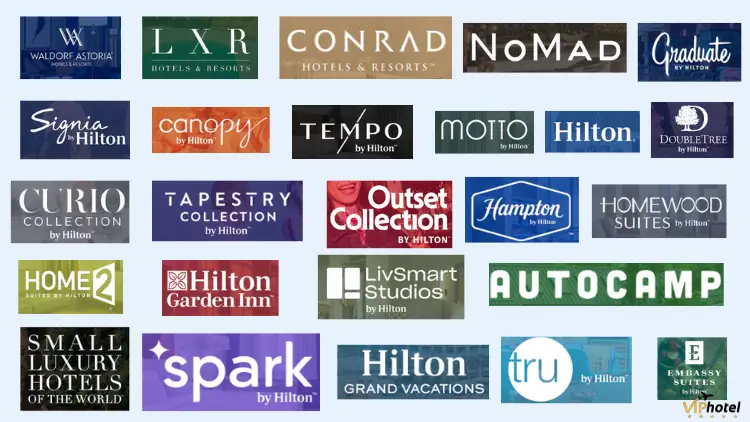
Hilton’s hotel network spans more than 100 countries and regions, with over 7,000 properties worldwide. The group operates 25 brands that cover a wide range of segments—including ultra-luxury, luxury, upscale, upper-midscale, and lifestyle accommodations—offering guests a diverse selection of stays. No matter the purpose of your trip, you can always find a Hilton hotel that suits your needs.
Key brands include:
Waldorf Astoria: A historic ultra-luxury brand known for exceptional service and iconic properties.
Conrad: A contemporary luxury brand tailored to high-end business travelers.
Hilton Hotels & Resorts: The group’s flagship brand with the widest global presence.
DoubleTree by Hilton: Famous for its warm, welcoming guest experience and signature chocolate chip cookies.
Hampton by Hilton: A highly popular mid-scale brand known for great value, located across major transportation and business hubs worldwide.
In summary, Hilton primarily targets the upper-midscale and upscale markets. Its brands are well-aligned, with a high degree of service standardization, making it a favorite among business travelers, international tourists, and loyalty members. Its loyalty program—Hilton Honors—is among the most respected in the industry, offering strong advantages in free night redemptions, elite status benefits, and points partnerships.
With consistent service quality, a strong global footprint, and powerful brand influence, Hilton has become one of the top choices for both business and leisure travelers around the world.
Overview of Wyndham Hotels Group:

Wyndham Hotels & Resorts was founded in 1981 and is headquartered in Parsippany, New Jersey, USA. Compared with Hilton, Wyndham is a younger hotel group, but through rapid expansion in the economy and midscale hotel markets, it has grown into one of the largest hotel chains in the world by number of properties. Its predecessor, Wyndham Worldwide, was one of its subsidiaries.
Wyndham currently operates over 9,000 hotels across 95 countries and regions, with more than 20 brands covering economy and midscale hotels, as well as some upscale resorts. It has particularly strong market penetration in roadside hotels, vacation resorts, and budget accommodations.
Major Wyndham brands include:
- Days Inn: An economy brand widely present in North America, Asia, and Europe, known for its affordable pricing.
- Super 8: A common economy brand along highways, offering simple and convenient stays.
- Ramada: One of Wyndham’s most internationally recognized midscale brands, widely distributed across Asia, Europe, and the Americas, known for quality accommodations and a welcoming atmosphere.
- Wyndham Grand: Wyndham’s upscale brand, providing high-quality stays in city centers and resort destinations.
- La Quinta: A midscale brand commonly found in the southern and western United States.
Beyond traditional hotel operations, Wyndham has also been involved in vacation ownership and rental businesses, establishing a solid presence in the resort and vacation-stay market. With over 9,000 properties in more than 95 countries, Wyndham is an undisputed leader in the economy hotel sector.
Core strengths of Wyndham include:
- A widespread network of economy hotels
- Highly competitive pricing
- Brand positioning geared toward mass-market travelers and road-trippers
- A simple loyalty program, Wyndham Rewards
Thanks to its vast property portfolio, flexible positioning, and high cost-effectiveness, Wyndham has become a popular choice for budget travelers, self-driving tourists, and families worldwide.
Is Wyndham Part of Hilton?
No. Wyndham is not part of Hilton.
First of all, Wyndham Hotels & Resorts and Hilton Hotels & Resorts are completely independent companies with no affiliation. Each has its own brand portfolio, management structure, and loyalty program. They are neither parent and subsidiary, nor have they ever merged or been acquired by each other—they are separate, publicly listed global hotel groups.
Why do some people confuse them as the same company?
Although the two groups are entirely independent, travelers often mix them up for several reasons:
- Similar brands and positioning: Both Hilton and Wyndham operate over 20 brands each. For example, Hampton (Hampton by Hilton) is sometimes mistakenly thought to belong to Wyndham, and some travelers incorrectly assume Ramada is part of Hilton. Most of these misunderstandings stem from unfamiliarity with brand ownership.
- Overlap in economy and midscale segments: Some brands have similar names, such as “Days Inn,” “Hampton Inn,” and “La Quinta Inn,” but they belong to different groups. Words like “Grand” or “Garden” appear in multiple brand names across different groups, further adding to the confusion.
In short, Hilton and Wyndham have never merged or formed any strategic alliance. Their loyalty programs and points systems are separate. They target different market segments: Hilton focuses on upscale and business travelers, while Wyndham specializes in economy and midscale accommodations. They are distinct companies with clear differences and are not part of the same hotel group.
Related Articles:
- Is Hilton part of Marriott?
- Is Wyndham Part of Marriott?
- Is Hilton part of Hyatt
- Is Hyatt part of Marriott
- Is Marriott part of IHG
Hilton vs Wyndham: Key Differences
Although both Hilton and Wyndham are globally recognized hotel groups, they differ significantly in market positioning, brand portfolios, service standards, and loyalty programs. Understanding these differences can help travelers quickly choose the hotel brand that best suits their needs.
1. Brand positioning and market strategy.
Hilton focuses on the upper-midscale to luxury segment, providing travelers with premium business experiences and luxury accommodations. Its portfolio includes luxury brands such as Waldorf Astoria and Conrad, as well as midscale options like Hampton and Hilton Garden Inn.
Overall positioning: Business, leisure, upscale experiences, and international travelers. Hilton is particularly suited for business trips, vacations, and international travel.
Wyndham, on the other hand, focuses on economy and midscale segments, operating the world’s largest number of economy hotel brands such as Super 8 and Days Inn, as well as mid- to upper-midscale brands like Ramada and Wyndham Grand. Wyndham is ideal for budget-conscious travelers, families, and road-trippers seeking affordable, convenient stays.
2. Global hotel count and distribution.
Wyndham operates over 9,000 hotels worldwide, making it one of the largest hotel groups by property count. Its hotels are often found along highways, in suburban areas, near airports, and at vacation destinations, mainly in the economy segment.
Hilton operates around 7,000 hotels in more than 100 countries, with a strong presence in Europe, North America, Asia, and key resort destinations. Compared with Wyndham, Hilton has a far greater proportion of high-end properties.
3. Loyalty program differences: Hilton Honors vs Wyndham Rewards.
Hilton Honors:
Hilton Honors has a clear elite status system with three levels: Silver, Gold, and Diamond. Members can earn points redeemable for free nights, room upgrades, airline miles, and special experiences. Gold and Diamond members enjoy additional perks such as free breakfast, room upgrades, and executive lounge access.
Elite status qualification criteria:
- Hilton Silver Status: 10 nights, 4 stays, or 25,000 base points
- Hilton Gold Status: 40 nights, 20 stays, or 75,000 base points
- Hilton Diamond Status: 60 nights, 30 stays, or 120,000 base points
Friendly Reminder:
Using the VIP Hotel Flights Fast Track service to upgrade your Hilton status allows you to skip the challenges and accelerate your elite upgrade. If you are a friend or family member of a Hilton employee, you may take advantage of the Hilton Friends and Family Discount Rate Plans, which offer up to 50% off.
If you are just a few nights short of reaching Gold or Diamond status, consider doing a Hilton mattress run. And if you wish to fast-track your way to Diamond, you can enroll in the Hilton Diamond Status Challenge—complete 14 nights within 90 days to earn Hilton Diamond status.
Related Articles:
- Upgrade to Hilton Gold Status: VIP Flights Fast Track
- Upgrade to Hilton Diamond Status: Quick Guide
- Quick Guide to Upgrade Hilton Diamond Status Challenge
- Explore Hilton Friends and Family Rate
- Hilton Free Breakfast: What You Need to Know
Wyndham Rewards:
Wyndham Rewards is the global loyalty program of Wyndham Hotels & Resorts. Members can earn reward points and enjoy benefits such as free nights, room upgrades, and various on-property perks. The program is well-suited for travelers seeking affordable and flexible redemption options. Its biggest advantage is its simple points redemption structure (fixed at 7,500 / 15,000 / 30,000 points), making it easy to earn and redeem—especially convenient for families and road-trip travelers.
The program is divided into four elite tiers:
- Blue (Regular Member): Free registration, no challenge required.
- Gold: Stay 5 nights in a calendar year.
- Platinum: Stay 15 nights in a calendar year.
- Wyndham Diamond: 40 nights in a calendar year.
Related Articles: How to Get Wyndham Diamond Status Quickly.
Benefits: Hilton Honors VS Wyndham Rewards
Hilton Honors offers more comprehensive elite benefits, such as room upgrades, lounge access, and room guarantees, compared to Wyndham. Although Wyndham is simpler in terms of bonus points and other aspects, it has flexible promotions (such as status upgrade + 5× points event in 2025), wide coverage of check-ins, and its “Insider Subscription Plan” provides additional value, making it suitable for budget and mid-range travelers. The following is a comparison table of the benefits of both plans.
| Category | Hilton Honors | Wyndham Rewards |
|---|---|---|
| Elite Levels | Member / Silver / Gold / Diamond | Blue / Gold / Platinum / Diamond |
| Qualification | – Silver: 10 nights / 4 stays / 25k base points – Gold: 40 nights / 20 stays / 75k base points – Diamond: 60 nights / 30 stays / 120k base points | – Gold: 5 nights – Platinum: 15 nights – Diamond: 40 nights |
| Points Bonus | Silver: +20% Gold: +80% Diamond: +100% | Gold: +10% Platinum: +15% Diamond: +20% (plus promos) |
| Room Upgrades | Gold: space-available upgrades Diamond: suite upgrades + lounge access | Diamond: suite upgrades (when available) + welcome gift |
| Guarantees / Flexibility | 48-hour room guarantee (Diamond) Elite nights rollover | Early check-in & late checkout (availability-based) |
| Wi-Fi | Free Wi-Fi for all members , Premium Wi-Fi for Diamond | Free Wi-Fi for all members (varies by hotel) |
| Food & Beverage | Gold: daily food & beverage credit / breakfast Diamond: lounge access | Diamond: welcome snack or drink |
| Status Extension / Gifting | Diamond can extend status + gift elite status | Diamond can gift Gold status |
| Special Perks | 5th night free on award stays | Gold: daily food & beverage credit/breakfast Diamond: lounge access |
Related Articles:
- Hilton VS Marriott Rewards: Which Loyalty Program Wins?
- IHG vs Hilton: Best Loyalty Programs Compared
- Hilton Gold vs Diamond: Which is better?
- Hyatt VS Hilton: Which is Better?
- Hilton Gold VS Marriott Gold: Ultimate Comparison
- Hilton Diamond VS Marriott Platinum
- Hyatt Globalist vs Marriott Titanium Elite
- Marriott MMP VS MMF: Which Saves Money?
- Hilton VS Marriott Friends and Family Discount Comparison
- Marriott MMP vs MM4: Employee Rate Guide
4. Differences in Brand Portfolio:
Hilton’s brands are primarily concentrated in the upper-midscale to luxury segments, with a unified brand image that emphasizes service quality and international standards. Examples include:
- Luxury: Waldorf Astoria, Conrad
- Upscale: Hilton Hotels & Resorts, Curio Collection
- Midscale: DoubleTree, Hampton, Hilton Garden Inn
- Lifestyle: Canopy, Motto
Wyndham’s brands mainly cover the economy to midscale segments, designed for budget-conscious travelers. Its brand portfolio is more diverse and focuses on practicality and convenience rather than premium positioning. Examples include:
- Economy: Super 8, Days Inn, Howard Johnson
- Midscale: Ramada, Wyndham, La Quinta
- Upscale: Wyndham Grand
5. Differences in Target Guests:
Hilton tends to attract business travelers, international travelers, luxury vacation guests, and loyal members seeking elevated travel experiences.
Wyndham is better suited for road-trippers, families, budget travelers, and guests seeking quick, convenient, and affordable accommodations.
6. Differences in Service Standards and Experience:
Compared with Wyndham, Hilton offers more consistent and standardized service across Europe, North America, and Asia, with high control expectations. Examples include:
- Standardized Hampton breakfast
- DoubleTree’s signature warm chocolate chip cookie
- Uniform bedding and mattress comfort standards at Hilton
Wyndham adopts a more flexible franchise model, resulting in greater variation in property quality. Economy brands generally provide more basic facilities and simpler service experiences.
7. Price Differences:
Overall, Hilton’s average room rates are higher than Wyndham’s because Hilton focuses on the midscale, upscale, and luxury markets.
Wyndham, with its strength in economy hotels, typically offers more affordable and budget-friendly prices compared with Hilton.
How Travelers Can Distinguish Between Wyndham and Hilton
When travelers book hotels, they often confuse the brands of these two groups. In reality, Hilton and Wyndham differ significantly in brand structure, market positioning, and pricing tiers. Fortunately, you only need to remember a few key points to distinguish them easily.
First, the most direct way to identify the brand is through the name: hotels that include “by Hilton” or are directly named “Hilton”, such as Hampton, DoubleTree, and Conrad, almost always belong to Hilton. Meanwhile, names such as Ramada, Days Inn, Super 8, and Howard Johnson are almost exclusively part of Wyndham.
Additionally, Hilton focuses on midscale to luxury hotels, offering highly standardized service and generally higher prices. Wyndham, on the other hand, primarily targets the economy and midscale markets, with strong presence in small and medium-sized cities; its economy brands are especially common.
You can also distinguish them through their loyalty programs. Hilton Honors, popular among business travelers, offers extensive benefits such as free breakfast, room upgrades, and executive lounge access. Wyndham Rewards has a simpler, more straightforward redemption system, making it ideal for budget travelers or occasional guests.
Hotel appearance and brand logos also help: Hilton brands tend to feature modern and professional visual design, while Wyndham brands commonly use light blue, white, and other friendly color tones.
Lastly, booking platforms such as Booking.com or Agoda clearly indicate hotel group affiliations—e.g., “Ramada by Wyndham” or “Hampton by Hilton.”
With these identification tips, whether you’re traveling for business or taking a family road trip, you can easily determine which hotel group a property belongs to and avoid confusion.
Wyndham Vacation Club vs Diamond Resorts (Hilton Vacation Club)
| Comparison Factor | Wyndham Vacation Club | Diamond / Hilton Vacation Club (HVC) |
|---|---|---|
| Brand Positioning | Large-scale, budget-friendly, family-oriented | High-end, flexible, experience-focused |
| Number of Resorts | 200+ (mostly in North America) | Fewer resorts, concentrated in premium destinations |
| Price / Costs | Lower upfront fees and annual dues | Higher fees, more complex structure |
| Resale Value | Low, but fewer restrictions | Heavily restricted, value declines significantly |
| Points Flexibility | Uses RCI network, broad exchange options | Can redeem for cruises, tours, and non-traditional vacations |
| Resort Quality | Mid-to-high, quality varies | More luxurious and boutique-focused |
| Booking Availability | Wide options but high competition at popular locations | Fewer properties but higher quality, stable bookings |
| Family-Friendly | Yes, many family-oriented resorts | Available, but more luxury-focused |
| Loyalty Program | Wyndham Rewards (useful but moderate impact) | Integrated into Hilton, strong loyalty benefits |
| Customer Service | Reliable and stable | Aggressive sales tactics historically, Hilton has improved experience |
| Traveler Pricing | More affordable | Significantly higher |
| Traveler Experience | Wide selection | High-end luxury, diverse experiences |
| Traveler Trust | Reliable, standard | Strong trust due to Hilton branding |
| Best for Travelers | Budget-conscious, family trips, diverse choices | Luxury seekers, unique vacation experiences (cruises, tours) |
| Best for Owners | Buyers seeking value and exchange flexibility | Buyers prioritizing quality and brand prestige |
| Overall Strengths | Affordable, diverse, family-friendly | Luxurious, unique experiences, strong brand |
| Overall Weaknesses | Aggressive sales tactics historically, Hilton improves experience | Expensive, restricted, smaller network |
| Key Advantage Areas | Cost, flexibility, service, selection | Luxury, experience, loyalty program, brand reputation |
| Final Takeaway | Winner for value and variety | Some resorts are outdated, weak resale market |
FAQ
Is Wyndham part of Marriott or Hilton?
No. Wyndham Hotels & Resorts is not part of Marriott or Hilton. All three are completely independent hotel groups and direct competitors. They have no affiliation with one another, and each company operates its own portfolio of brands and loyalty program.
What chains are part of Wyndham?
Wyndham operates 25 hotel brands across a wide range of segments, from economy to upscale. Its major brands include upscale options such as Wyndham, Wyndham Grand, and Dolce; popular business-friendly and mid-scale brands such as La Quinta, Wingate, Wyndham Garden, and Hawthorn Suites; as well as many well-known economy brands like Ramada, Days Inn, Super 8, Howard Johnson, Travelodge, Baymont, and Microtel. With this diverse portfolio, Wyndham offers accommodation choices for travelers of all budgets and needs.
Does Hilton status match Wyndham?
Yes. Hilton Gold members can be matched directly to Wyndham Diamond status. You need a Wyndham Rewards account, then submit the status-match request form along with proof of your current Hilton elite level. After a short review period, the match will be completed.
What hotel chains are part of Hilton?
Hilton currently has 25 hotel brands across various categories:
Luxury Brands
Waldorf Astoria
Conrad
LXR Hotels & Resorts
Upper-Upscale Brands
Hilton Hotels & Resorts
Curio Collection by Hilton
Tapestry Collection by Hilton
DoubleTree by Hilton
Upscale & Select-Service Brands
Hilton Garden Inn
Hampton by Hilton
Tru by Hilton
Spark by Hilton
Lifestyle & Meetings/Resort Brands
Canopy by Hilton
Tempo by Hilton
Motto by Hilton
Signia by Hilton
Extended-Stay & Vacation Ownership Brands
Homewood Suites by Hilton
Home2 Suites by Hilton
Embassy Suites by Hilton
Hilton Grand Vacations
LivSmart Studios by Hilton
All-Inclusive Resorts
Hilton Cancun All-Inclusive and other All-Inclusive collections
Other / Emerging Brands
Denizen Hotels
Project H3 / Extended-Stay brand (name pending)
Is Holiday Inn part of Hilton?
No. Holiday Inn is not a Hilton brand; it belongs to IHG (InterContinental Hotels Group). Although both operate globally, they are completely separate hotel companies with different brand structures, management systems, and loyalty programs.
Is Sheraton part of Hilton?
No. Sheraton is not part of Hilton; it is a brand under Marriott International. As one of Marriott’s oldest and largest brands, Sheraton is entirely independent from Hilton and maintains its own operating system and loyalty program.
Conclusion
Based on everything explained above, if anyone asks you, “Is Wyndham part of Hilton?” you can confidently answer No.
In summary, Wyndham is not part of Hilton. The two companies are completely independent in terms of history, market positioning, brand structure, and loyalty programs, and they operate as competitors in the global hotel industry. Hilton focuses more on upscale and business travelers, offering a more unified brand image and higher service standards. Wyndham, meanwhile, centers around economy and midscale hotels, with broader coverage and more diverse choices—especially suitable for budget-conscious guests and road-trippers.
They are two separate publicly listed companies—industry peers, but also competitors. Therefore, when making a booking, you should decide based on your budget, location, travel needs, brand preference, and loyalty benefits. If you value a premium experience, want lounge access, free breakfast, and room upgrades, Hilton is an excellent choice. If you want convenience, affordability, and are traveling with family, Wyndham is likely the better fit.
Once you understand the fundamental differences between these two groups, you’ll be able to quickly identify which brand belongs to which company—whether it’s Hampton, Ramada, Conrad, or Super 8—and confidently choose the hotel that best fits your trip, making your journey smoother and more enjoyable.